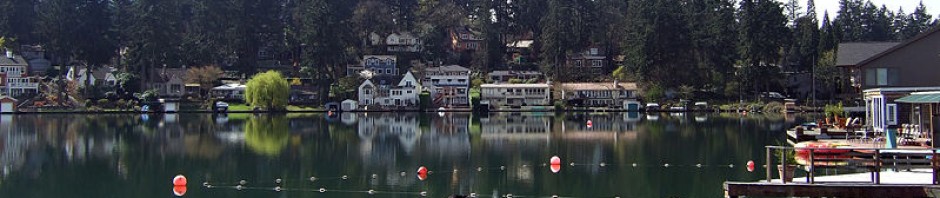
If you’re shopping for a home in Lake Oswego, you’ve probably come across listings that advertise “lakefront,” “lake easement rights,” or “lake access.” More recently, you may have also heard about public access to Oswego Lake following years of legal challenges.
So, what do these terms actually mean?
The answer can have a significant impact on a home’s value, lifestyle, and long-term enjoyment. Here’s a straightforward guide to understanding the three different ways people can enjoy Oswego Lake.
Option 1: Owning a Home on Oswego Lake
This is the gold standard of lake living.
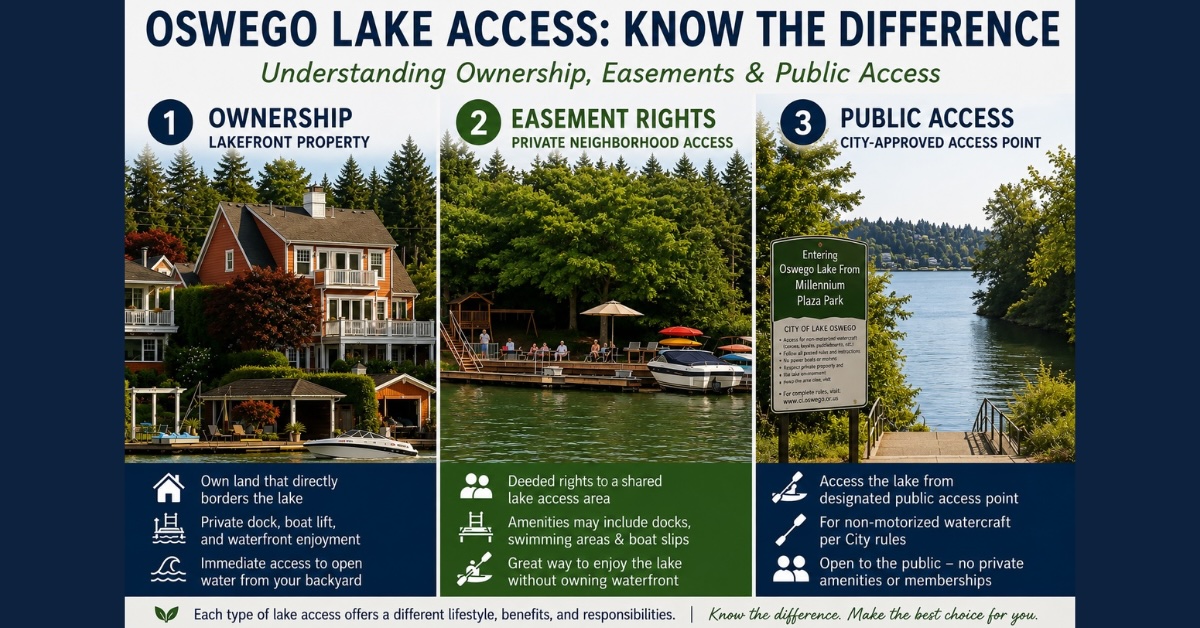
Lakefront homeowners own property that directly borders Oswego Lake, allowing them to enjoy immediate access from their own backyard. Depending on the property, owners may have a private dock, boat lift, swimming area, or shoreline seating.
For many buyers, the appeal is obvious:
- Walk from your patio to your dock.
- Keep your boat at home.
- Paddleboard or kayak whenever you’d like.
- Enjoy waterfront views every day.
Not All Lakefront Homes Offer the Same Experience
Even among lakefront homes, there is a hierarchy. Generally speaking, homes on the main lake command the highest prices, followed by canal-front properties. But each offers its own unique advantages.
Main lake homes provide immediate access to open water, allowing homeowners to leave the dock and head straight out for waterskiing, wakeboarding, or cruising. Canal-front homeowners, on the other hand, enjoy a leisurely ride through the neighborhood canals before reaching the main lake, where higher speeds are permitted.
For many canal owners, that peaceful journey is part of the appeal. The quiet canals create a more tranquil setting, with less boat traffic and noise, making morning paddleboard rides, kayaking, or simply relaxing by the water especially enjoyable.
Canal-front properties also tend to offer larger, flatter backyards, giving homeowners the best of both worlds: private lake access and generous outdoor living space. While there are certainly exceptional main lake estates with expansive grounds, many main lake homes are built on steeper lots to maximize panoramic water views, often resulting in smaller or more sloped backyards.
Ultimately, the “best” choice comes down to lifestyle. Some buyers prioritize immediate access to open water and sweeping lake views, while others value a quieter setting and a larger yard for entertaining, gardening, or simply enjoying time outdoors.
Understanding the Costs of Lakefront Ownership
Lakefront living comes with incredible benefits, but it’s also important to understand the ongoing costs associated with owning property on Oswego Lake.
In addition to regular property taxes and home maintenance, lakefront homeowners are typically members of the Lake Oswego Corporation (LOC), the private entity that owns and manages Oswego Lake. Annual assessments help fund the operation and maintenance of the lake, including water quality management, dam maintenance, aquatic vegetation control, dredging, safety programs, and other improvements that keep the lake healthy and enjoyable for everyone who uses it.
Depending on the property, owners may also incur additional expenses for maintaining private docks, boat lifts, seawalls, or shoreline improvements. If a home is part of a homeowners association, there may be HOA dues as well.
While these costs are an important part of lakefront ownership, many homeowners view them as a worthwhile investment in preserving one of Lake Oswego’s most unique and desirable amenities. The result is a well-maintained lake that continues to support boating, swimming, paddleboarding, fishing, and waterfront living while helping protect long-term property values.
As with any home purchase, it’s important to understand the specific assessments, memberships, and maintenance responsibilities associated with an individual property before closing. A knowledgeable local Realtor can help you identify these costs early in the buying process so there are no surprises.
Option 2: Lake Easement Rights
This is where many buyers have questions.
A lake easement gives certain property owners the right to use Oswego Lake through a designated neighborhood access point—even though they don’t own waterfront property.
These rights are attached to specific properties, not to the individual owner. In other words, if a home has valid lake easement rights, those rights generally transfer with the property when it’s sold. They aren’t something that can be bought separately or added later simply because someone lives nearby. Eligibility is based on historic deeds and covenants established decades ago.
What does an easement typically include?
Every easement association is a little different, but many offer amenities such as:
- Swimming areas
- Shared docks
- Boat slips (sometimes available through a waiting list or additional fee)
- Canoe, kayak, and paddleboard storage
- Picnic tables and gathering areas
- Seasonal social events
Some easements are quite modest, while others feel like private waterfront parks with extensive amenities.
Because each easement is unique, it’s important to understand exactly what comes with a particular property before purchasing.
Not All Easements Are Created Equal
One of the biggest misconceptions is that all lake easements offer the same experience.
They don’t.
Lake Oswego has 20 recognized easement areas, and each has its own membership structure, facilities, dues, and rules. Some have large sandy beaches and expansive gathering spaces. Others are designed primarily for launching kayaks or storing watercraft. Some have restrooms, boat slips, or community docks, while others are much simpler. The Lake Oswego Corporation recognizes easement privileges based on recorded property rights, and each easement association manages its own operations and amenities.
That’s one reason working with a Realtor who understands the differences can be so valuable. Two homes with “lake easement rights” may offer very different experiences. Here’s a previous blog that breaks down the differences among the different easements.
Option 3: Public Access to Oswego Lake
This is the newest—and perhaps most talked-about—way to access Oswego Lake.
Following years of litigation over public access, court rulings have required the City of Lake Oswego to provide public access from Lower Millennium Plaza Park. The implementation and scope of that access have evolved as legal proceedings have continued, so it’s a topic that remains closely watched.
Public access is different from lake easement rights in several important ways as we discuss in a previous blog.
It does not provide membership in an easement association or access to private easement parks, docks, boat slips, or neighborhood amenities. Instead, it provides a designated point where members of the public may access the water with non-motorized watercraft and in accordance with the City’s rules and any applicable court orders. You can read the rules here.
All Lake Oswego residents also have access to the Lake Oswego Swim Park during its summer hours from July 1 through August 31. And all Lake Oswego residents who live within the original Lake Grove School District boundary have access to the Lake Grove Swim Park.
Read more about these swim parks in one of our earlier blogs.
Which Option Is Right for You?
The answer depends on the lifestyle you’re looking for.
Lakefront ownership offers unmatched convenience, privacy, and direct access—but it also comes with the highest price tag.
Lake easement rights can be an excellent alternative, giving homeowners access to the lake and many recreational amenities without the cost of waterfront ownership.
Public access allows everyone to enjoy Oswego Lake from designated public access points, but it doesn’t include the private amenities associated with lakefront ownership or neighborhood easements.
Why This Matters When Buying a Home
One of the biggest mistakes buyers make is assuming that every home “near the lake” comes with lake access.
In reality, two homes on the same street can have completely different lake privileges. One may include access to a beautiful easement with docks and swimming areas, while the home next door may have no private lake rights at all.
That’s why it’s essential to verify exactly what a property includes before making an offer. The Lake Oswego Corporation even provides an address lookup tool to determine whether a specific property has recognized lake easement privileges.
The Bottom Line
Oswego Lake is one of the defining features of Lake Oswego, but not all access is the same. Understanding the difference between lakefront ownership, deeded lake easement rights, and public access can help you make a more informed decision and avoid surprises after closing. Whether you’re dreaming of a private dock, a neighborhood swim park, or simply enjoying time on the water, knowing exactly what comes with a property is just as important as the home itself.
If you’re considering buying in Lake Oswego, we’d be happy to help you understand these nuances and which neighborhoods and homes will deliver the benefits you are looking for at a price you can afford. Give us a call.
Kevin Costello kevin.costello@cascadehasson.com 503.939.9801
Riley Costello riley.costello@cascadehasson.com 971.322.6205


